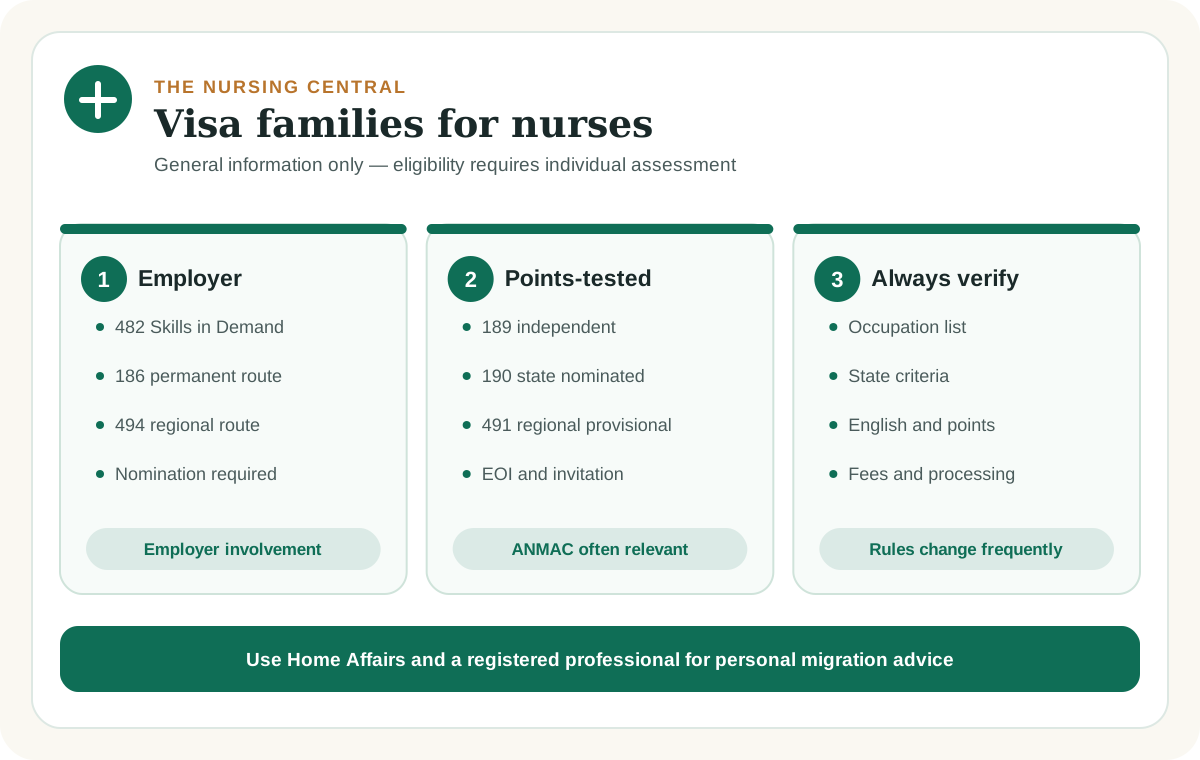
If you are a nurse looking to migrate to Australia, the visa system is the most expensive, slowest, and most confusing part of the whole journey. There are six different visa subclasses that matter for nurses — 482, 186, 494, 189, 190 and 491 — and the rules around each have changed significantly in 2024 and 2025. This guide explains all of them, what they cost in 2026, how long they actually take, and which one fits your situation.
The information below is based on official Department of Home Affairs sources, current to mid-2026. Fees and thresholds increase every 1 July, so always cross-check with the Department before lodging.
The 6 visas for nurses, at a glance
Before going deep, here is the one-screen overview. The “type” column is the most important: it tells you whether the visa is permanent from day one, or whether it leads to permanent residency later via another visa.
| Visa | Name | Type | Sponsor needed? | Leads to PR via |
|---|---|---|---|---|
| 482 | Skills in Demand | Temporary (up to 4 yrs) | Yes — employer | 186 TRT after 2 yrs |
| 186 | Employer Nomination Scheme | Permanent | Yes — employer | — |
| 494 | Skilled Employer Sponsored Regional | Provisional (5 yrs) | Yes — regional employer | 191 after 3 yrs |
| 189 | Skilled Independent | Permanent | No | — |
| 190 | Skilled Nominated | Permanent | State nomination | — |
| 491 | Skilled Work Regional | Provisional (5 yrs) | State or family | 191 after 3 yrs |
Notice the pattern: three of these visas (482, 494, 491) are stepping stones. They give you the right to live and work in Australia for a few years, and then you transition to a permanent visa later. The other three (186, 189, 190) are permanent from grant — you get permanent residency on day one.
Two big questions decide everything
Before reading the rest, answer these two questions in your head:
- Do you have an Australian employer willing to sponsor you? If yes, the sponsored visas (482, 186, 494) are your path. If no, you go via independent skilled migration (189, 190, 491).
- Are you willing to live and work in regional Australia for a few years? “Regional” in visa terms means anywhere except Sydney, Melbourne, and Brisbane — yes, Perth, Adelaide, the Gold Coast and Hobart all qualify as regional. If you are open to regional, you unlock 494, 491 and significantly more state-nomination options under 190.
If you are not sure which one applies to your situation, the eligibility wizard walks you through six questions and gives you a personalised pathway in about two minutes.
Employer-sponsored visas: 482, 186, 494
These three visas all require an Australian employer to nominate you for a specific position. The employer also has to be an approved sponsor with the Department of Home Affairs, which is its own multi-step process the employer goes through before they can even nominate you.
Subclass 482 — Skills in Demand (SID)
The Skills in Demand visa is the most common starting point for international nurses without an immediate path to permanent residency. It launched on 7 December 2024, replacing the old Temporary Skill Shortage (TSS) visa. The structure changed: instead of a flat visa with two streams (short-term and medium-term), the SID now has three streams based on what the employer pays you:
- Core Skills stream — for salaries above the Core Skills Income Threshold (CSIT). This is the stream most nurses fall into. The CSIT is AUD $76,515 as of 2026 and rises to $79,499 from 1 July 2026 (indexed annually to AWOTE).
- Specialist Skills stream — for high-earners above the Specialist Skills Income Threshold (SSIT) of $141,210, rising to $146,717 from 1 July 2026. Rare for ward nurses, more relevant for nurse practitioners or senior clinical roles.
- Essential Skills stream — for designated occupations including aged care nursing. Different criteria, lower salary threshold.
What you need to qualify
- AHPRA registration (or in-principle registration at minimum)
- Your nominated occupation must be on the Core Skills Occupation List (CSOL) — Registered Nurse occupations are listed
- At least 1 year of relevant full-time experience in the past 5 years (reduced from 2 years when SID launched)
- English at “Vocational” level — IELTS 5.0 overall, minimum 5 per band, or equivalent
- A sponsoring employer who is an approved Standard Business Sponsor
- The salary offered must meet or exceed the relevant income threshold AND the market rate for the role
Realistic costs and timeline
- Visa application charge: AUD $3,210 main applicant, $3,210 per additional adult, $805 per child (Core Skills stream, post 1 July 2025)
- Employer pays: sponsorship and nomination fees (around $420 + $330), plus the SAF (Skilling Australians Fund) levy — $1,200/year for small business, $1,800/year for large business, paid upfront for the visa duration
- Processing time: 6–14 months from sponsorship lodgement to visa grant, depending on stream and employer status
One critical point: the visa is tied to the sponsoring employer. If you leave the job, you have 180 days to find another sponsor or you must leave Australia. That dependency is the biggest psychological cost of the 482, and the reason most nurses use it as a stepping stone to a permanent visa rather than a destination.
Subclass 186 — Employer Nomination Scheme (ENS)
The 186 is permanent residency from grant. It is the most direct employer-sponsored route to PR for nurses. There are three streams:
- Direct Entry (DE) — for applicants who have NOT been working in Australia for the sponsoring employer for at least two years. Most overseas applicants fall here. Requires a skills assessment (ANMAC for nurses) and at least 3 years of relevant work experience.
- Temporary Residence Transition (TRT) — for 482 holders who have worked for the same sponsoring employer for at least 2 years (this was reduced from 3 years in November 2025 — a significant change). No new skills assessment usually required; your Australian employment is the proof.
- Labour Agreement stream — niche, only for sponsors with a formal labour agreement with the government.
What you need to qualify
- Under 45 years old at the time of lodgement (with exceptions for high-income earners and academics)
- Competent English — IELTS 6.0 overall, minimum 6 per band, or equivalent
- AHPRA registration
- Skills assessment from ANMAC (Direct Entry stream only)
- 3 years of relevant experience (Direct Entry) or 2 years with the sponsor (TRT)
- Occupation on the CSOL
Realistic costs and timeline
- Visa application charge: AUD $4,910 main applicant, $2,455 per additional adult, $1,230 per child (as of 1 July 2025)
- Processing time: 13–14 months for Direct Entry; faster for TRT (typically 6–10 months because the supporting evidence is already strong)
For most nurses, the realistic 186 path is via 482 first, then TRT after 2 years. The Direct Entry stream looks attractive on paper because it skips the 482 stage, but it is one of the harder permanent visas in the Australian system: 3-year experience requirement, mandatory skills assessment, and longer processing. If you have a genuine Australian sponsor and 3+ years of post-registration RN experience, Direct Entry is worth considering. Otherwise, the 482→TRT path is more achievable.
Subclass 494 — Skilled Employer Sponsored Regional
The 494 is a 5-year provisional visa for nurses willing to live and work in regional Australia. It is the regional cousin of the 482, with a clearer pathway to permanent residency via the Subclass 191 after three years.
“Regional” in visa terms is broader than people expect. Anywhere except Sydney, Melbourne and Brisbane qualifies. That means Perth, Adelaide, Hobart, the Gold Coast, Canberra, Darwin, Cairns, Newcastle, Wollongong and Geelong are all regional for visa purposes. For nurses, that opens up a lot of well-paying hospital and aged care work in genuinely livable cities.
What you need to qualify
- A regional employer who is an approved sponsor
- Occupation on the CSOL
- Skills assessment from ANMAC
- At least 3 years of relevant work experience (higher than the 482)
- Competent English (IELTS 6.0 / OET B equivalent)
- Under 45 years old
- Regional Certifying Body (RCB) approval — the employer must demonstrate the role cannot be filled locally
The 494 → 191 pathway to PR
After holding the 494 for 3 years and meeting the requirements, you apply for the Subclass 191 Permanent Residence (Skilled Regional) visa. The 191 requirements are:
- Held the 494 (or 491) for at least 3 years
- Taxable income at or above the minimum income threshold ($53,900/year) for at least 3 income years
- Complied with all visa conditions
One key advantage of the 494 → 191 pathway: the 191 does not require a new employer nomination. You apply directly to the Department based on your compliance record. That removes a significant step compared to the 186.
The trade-off: legislation limits 494 holders’ access to several other permanent visas (186, 189, 190) for 3 years after grant. You commit to the regional pathway.
Independent skilled migration: 189, 190, 491
These three visas do not require an employer sponsor. Instead, you submit an Expression of Interest (EOI) through the SkillSelect system, score points against the migration points test, and wait to be invited. The points test rewards age, English, work experience, qualifications, partner skills, regional study, and various other criteria.
For all three, you need an ANMAC skills assessment before you can even submit an EOI. AHPRA registration is required eventually but does not have to be in place at EOI stage for most applicants — it can be obtained in parallel.
Subclass 189 — Skilled Independent
The 189 is the prize visa in the Australian skilled migration system. It is permanent from grant, no sponsor needed, no state restrictions — you can live and work anywhere in Australia, including the big cities. The catch: it is highly competitive.
The points reality for nurses in 2025-26
The minimum to even submit an EOI is 65 points. But the practical cut-off — the score you need to actually be invited — is much higher. In the November 2025 invitation round, Registered Nurse (Medical) and Registered Nurse (Surgical) were invited at 80 points. General professional occupations needed 90+. Nursing is competitive but not the most contested category.
How nurses score 80 points (a realistic build)
- Age 25-32: 30 points
- Superior English (IELTS 8.0 / OET A / PTE 79): 20 points
- Bachelor degree (Registered Nurse qualification): 15 points
- 3+ years of skilled work outside Australia: 5 points
- 1+ year of skilled work in Australia: 5 points
- Skilled partner with Competent English: 5 points
- Total: 80 points
The cheapest and most reliable way to add points is re-sitting an English test. Going from Proficient (10 points) to Superior (20 points) adds 10 points instantly. For most nurses, the bottleneck is age or experience-in-Australia.
Realistic costs and timeline
- Visa application charge: AUD $4,910 main applicant, $2,455 per additional adult, $1,230 per child
- ANMAC skills assessment: $545 (Modified) to $595 (Full) — see the ANMAC guide
- Invitation rounds: quarterly, typically. The June 2026 round was the last of the 2025-26 program year. The 2026-27 program starts 1 July 2026.
- Processing time after invitation: 6–18 months depending on document completeness
- Important: once you get an invitation, you have only 60 days to lodge a complete visa application. Miss the deadline and the invitation is forfeited permanently.
Subclass 190 — Skilled Nominated
The 190 is structurally identical to the 189 — permanent visa, points-tested, no employer needed — with one critical difference: you need a state or territory to nominate you. The nomination adds 5 points to your score, which is often enough to push borderline candidates over the line.
Each state and territory has its own skilled occupation list, its own criteria, its own allocation, and its own invitation rhythm. For the 2025-26 program year, the total national allocation is 12,850 places for the 190 across all states.
Major state allocations for 2025-26 (190)
- NSW: 2,100 places — highest demand, highest competition. Selects highest-ranking EOIs within each ANZSCO unit group.
- ACT: 800 places — Canberra Matrix system, predictable scoring.
- Tasmania: weekly nomination rounds — aggressive program for the 2025-26 year.
- Victoria, Queensland, WA, SA, NT: own allocations and criteria, each with their own priority occupation lists.
The 190 commitment
The 190 is a “moral commitment” visa: when a state nominates you, you commit to live and work in that state for at least 2 years after grant. There is no formal penalty in the visa conditions, but states do monitor and your future visa applications can be affected if you abandon the commitment.
Realistic costs and timeline
- State nomination fee: varies by state, typically $300–$330
- Visa application charge: AUD $4,910 main applicant (same as 189)
- Total to invitation: 2–8 months depending on state
- Processing time after invitation: similar to 189, 6–18 months
Subclass 491 — Skilled Work Regional (Provisional)
The 491 is a 5-year provisional visa for skilled workers willing to live and work in regional Australia. It is the regional version of the 190, and it adds 15 points to your score (more than any other nomination), making it the easiest invitation to obtain. Two pathways:
- State-nominated stream: a state or territory nominates you for a regional area
- Family-sponsored stream: an eligible relative living in a regional area sponsors you
For the 2025-26 program year, the total 491 allocation is 7,500 places. Like the 494, the 491 leads to permanent residency via the Subclass 191 after 3 years of compliance — same requirements as for 494 holders.
Why the 491 often works better than chasing 189
Many nurses fixate on the 189 because it is permanent from day one. But if your points score sits at 75 or below — which is common for nurses outside the very narrow age band of 25-32 — the 189 is realistically out of reach. The 491 cut-offs are significantly lower, and the 3-year regional commitment leads to permanent residency without the lottery of waiting for an invitation round that may never reach your score. For nurses open to Perth, Adelaide, or Hobart, the 491 → 191 pathway often delivers PR faster than waiting for a 189 invitation that never comes.
Realistic costs and timeline
- State nomination fee: $300–$330 (varies)
- Visa application charge: AUD $4,910 main applicant
- Total to invitation: faster than 190 in most states
- Processing time after invitation: 6–14 months
How AHPRA and ANMAC fit in
Every visa pathway for nurses ultimately requires both AHPRA registration and, in most cases, an ANMAC skills assessment. The two are often confused but they are completely different things.
- AHPRA registration is your professional licence — you cannot legally work as a Registered Nurse in Australia without it. Required for all six visas above, although for 482, you can lodge the visa with in-principle registration and ID-verify later.
- ANMAC skills assessment is the visa-points qualification check. Required for the independent skilled migration visas (189, 190, 491) and for the Direct Entry stream of the 186 and the 494. Not strictly required for the 482 if you already have AHPRA, although many nurses do it anyway because it is needed for the 186 TRT down the line.
If you are starting from scratch, the rough order is usually: English test → AHPRA application → ANMAC skills assessment (in parallel with AHPRA, once you have your in-principle decision) → visa application. The two TNC guides cover each in detail:
- AHPRA Registration for Nurses 2026 — pathways, fees, and timelines
- ANMAC Skills Assessment for Nurses 2026 — Modified, Modified PLUS, Full and Direct Care pathways
Real cost comparison: from zero to PR
The visa application charge is only one piece of the total cost. Here is what a realistic budget looks like for a nurse coming from outside the approved IQRN list (so going via OBA for AHPRA), for the most common pathways:
| Component | 482 → 186 TRT | 189 / 190 | 491 → 191 |
|---|---|---|---|
| English test (OET / IELTS) | $400–$500 | $400–$500 | $400–$500 |
| AHPRA fees (OBA: NCLEX + OSCE + reg) | $7,000–15,000 | $7,000–15,000 | $7,000–15,000 |
| ANMAC skills assessment | Optional | $595 | $595 |
| State nomination fee | — | $0–$330 | $300 |
| Visa application charge (primary) | $3,210 + $4,910 | $4,910 | $4,910 |
| Medicals + police checks | $500–$800 | $500–$800 | $500–$800 |
| Total (rough) | $16,000–24,000 | $13,500–22,000 | $13,700–22,200 |
Add 30–50% more if you are bringing a partner and one or two children. The biggest variable is which AHPRA pathway you fall into: if you qualified in one of the six IQRN-approved countries (UK, Ireland, US, Canada, Singapore, Spain, Hong Kong) or have 1,800+ hours of work there since 2017, the AHPRA cost drops to AUD $1,500–4,500 and the total falls accordingly.
5 common visa mistakes nurses make
1. Treating the 482 as a destination instead of a stepping stone
The 482 is a great visa to enter Australia, but it ties you to one employer and runs out. Use the 2 years productively: build the work record needed for the 186 TRT, file your ANMAC, and ensure your employer is on board with sponsoring you for PR. Do not coast and find yourself with 3 months left on the visa and no PR plan.
2. Submitting only one EOI
For independent skilled migration, the smart move is to submit parallel EOIs across 189, 190 and 491. You only accept one invitation if invited to multiple. This triples your invitation surface area without any downside. Most applicants who get invited quickly do this.
3. Underestimating the English points lever
Going from Proficient English (10 points) to Superior English (20 points) is the cheapest, fastest 10 points you can add to your score. For most nurses, it makes the difference between “never invited” and “invited next round.” OET A or IELTS Academic 8.0 across all bands is the threshold. Re-sit until you hit it — it is worth the test fees.
4. Ignoring the partner skills points
A skilled partner with Competent English adds 10 points. Many applicants assume their partner does not qualify and never check. If your partner has a degree in an occupation on the CSOL and English at IELTS 6.0 / OET B, you get the points. The partner does not need to migrate as the primary applicant.
5. Letting an invitation expire
Once invited, you have only 60 days to lodge a complete visa application — including police checks from every country you have lived in for 12+ months, medical exams, and all supporting documents. Start gathering these the day you submit your EOI, not the day you receive the invitation.
How to choose between the six
The decision is not about which visa is “best” in the abstract — it is about which fits your specific situation. A simplified decision tree:
- Do you have an Australian employer offer? → 482 (Skills in Demand), then transition to 186 TRT after 2 years
- Are you open to regional Australia AND have an employer there? → 494 (Skilled Employer Sponsored Regional), then 191 after 3 years
- No sponsor, points score 85+? → 189 (Skilled Independent)
- No sponsor, points score 75–80, willing to commit to a state? → 190 (Skilled Nominated)
- No sponsor, points score 65–75, willing to live regionally? → 491 (Skilled Work Regional), then 191 after 3 years
- Already in Australia working aged care? → DAMA or 482 Essential Skills stream, depending on your role and region
Get personalised guidance
Not sure which visa fits your situation?
Take the free 2-minute eligibility wizard. Six questions about your country, qualification, experience and goals — and you get a personalised AHPRA pathway, ANMAC pathway, and the visa subclass most likely to apply to you. No signup, no email needed.
One last thing
The visa subclass numbers (482, 186, 494, 189, 190, 491) get rebadged, restructured and renamed every few years. The 482 was TSS until December 2024. The 187 was Regional Sponsored Migration Scheme until it closed. The 489 became the 491. Whatever the current names, the underlying pattern stays the same: sponsored or independent, temporary or permanent, anywhere or regional. Once you understand the four quadrants, the visa subclasses are just labels.
This guide is updated every time the Department of Home Affairs makes a material change to fees, thresholds or processing times. If you spot an error or something outdated, please let me know.
This article is for general educational purposes only and does not constitute migration advice. For visa-specific guidance, consult a Registered Migration Agent (MARA) or Migration Lawyer.
Related guide
Which English test should you sit — OET, IELTS, PTE or TOEFL?
The English test is usually the first concrete cost of the migration. Read the 2026 comparison guide — OET vs IELTS vs PTE vs TOEFL for AHPRA, with real fees, processing times and how to choose: OET vs IELTS vs PTE vs TOEFL for AHPRA 2026 →