If you’ve spent the last few weeks reading migration agency websites that conflate AHPRA with ANMAC, hand you visa advice when you ask about professional registration, and end every page with a $5,000 AUD upsell, you’re in the right place.
This guide isn’t a sales pitch dressed up as advice. I’m a Registered Nurse in Western Australia. I went through the AHPRA process myself, and I now help international nurses navigate it without losing months to avoidable mistakes. Here’s the AHPRA process step by step, with the new IQRN Streamlined Pathway (effective April 2025), realistic 2026 costs in AUD, the true processing times (not the official ones), and the five mistakes that can delay your registration by six months.
My story, in a nutshell: I trained in Spain (Diploma in Nursing, 2008–2011), then spent three years working in NHS hospitals in the UK and four years in the health insurance sector in Ireland. I arrived in Perth in April 2022.
I did my AHPRA registration in 2023, and it took me nine months to obtain full registration. It was a very stressful period because AHPRA is quite slow when it comes to getting back to you.
For example, they would request something today, I would send it the very same day, and then I would have to wait another four weeks for their reply, only for them to ask for something else, usually something simple that I could again provide straight away.
The most frustrating part was not the requests themselves, but the long waiting times between each one, which ended up dragging the whole process out for months.
What you’ll learn in this guide
- What AHPRA actually is and why it’s not the same as ANMAC (the #1 beginner mistake)
- The three IQNM Streams (A, B and C) and how to know which one applies to you
- The new IQRN Streamlined Pathway in effect since April 2025 — 6 countries can now skip NCLEX and OSCE entirely
- The OBA (Outcomes-Based Assessment): what it is, what it costs, where you sit it
- Real 2026 costs: the full picture, not just the official fees
- True processing times — AHPRA officially says 8-12 weeks, but reality is different
- The 5 mistakes that delay most AHPRA applications
- How to work in nursing while your AHPRA is in progress
Let’s get into it.
What is AHPRA, really? (And why it’s not ANMAC)
AHPRA stands for Australian Health Practitioner Regulation Agency. It’s the umbrella regulator for 15+ health professions in Australia. The specific board for nursing is the NMBA (Nursing and Midwifery Board of Australia).
The pathway for international applicants is called IQNM (Internationally Qualified Nurses and Midwives). This is what gives you the legal right to practise as a Registered Nurse in Australia.
Here’s the confusion that trips up almost every new applicant:
AHPRA ≠ ANMAC. These are two separate processes.
- AHPRA / NMBA grants you the professional registration you need to legally work as a nurse in Australia
- ANMAC assesses whether your qualification is comparable to the Australian standard, for migration purposes only (visa)
They can run in parallel, but they’re separate processes with different criteria, different fees, and different governing bodies. I’ve seen plenty of nurses pay for ANMAC first thinking it lets them practise — it doesn’t. Without AHPRA, you cannot work as a nurse in Australia, even with a valid working visa.
What you do first depends on your goal
| Your goal | Do this first |
|---|---|
| Start working with an employer sponsor (subclass 482) | AHPRA first, ANMAC optional |
| Permanent Residency via skilled migration (189/190/491) | Both in parallel |
| Arrive on Working Holiday and register here | AHPRA while onshore |
| Arrive on a Student visa for a Master of Nursing | AHPRA on completion |
The big 2025-2026 news: the new IQRN Streamlined Pathway
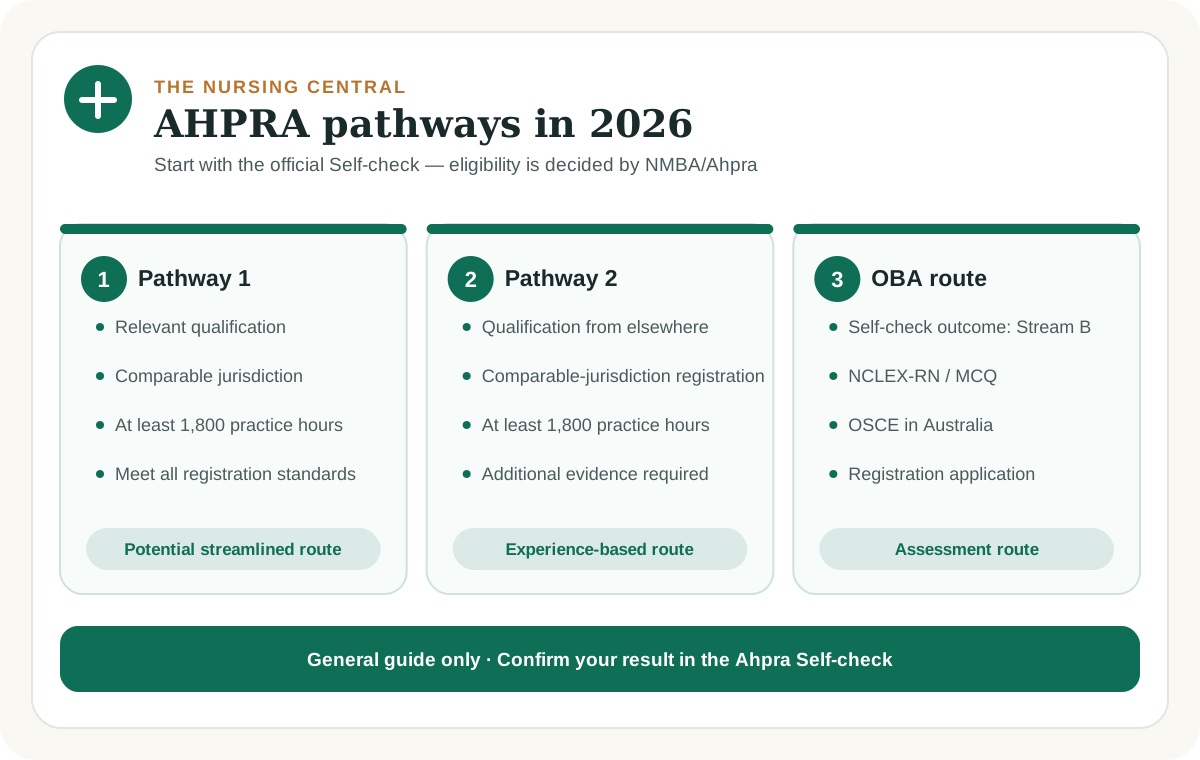
In April 2025, AHPRA introduced a new Registration Standard: “General Registration for Internationally Qualified Registered Nurses (IQRNs)”. It adds two new pathways that can shorten your registration from 18 months to 1-6 months if you’re eligible.
Pathway 1: For nurses from 6 specific countries
You’re eligible if:
- You trained AND were registered in one of these 6 countries: United Kingdom, Ireland, USA, Canada (British Columbia and Ontario only), Singapore, or Spain
- You hold current registration in your home country
- You meet AHPRA’s English language requirements
Spain newly included from April 2025 — this was the biggest news for Spanish nurses in years. Until March 2025, Spanish-trained nurses went through Stream B (NCLEX + OSCE). From April 2025 onwards, they go through the accelerated pathway.
Realistic 2026 timeline: 1-6 months from application to registration.
Pathway 2: For nurses with practice experience in an approved country
You’re eligible if:
- You trained in any country (including India, the Philippines, Latin America, the Middle East, etc.) BUT
- You’ve worked at least 1,800 hours as a Registered Nurse since 1 January 2017 in one of the 6 approved countries
- You maintain current registration in that approved country
This is the side door for nurses from non-approved countries who moved to the UK, Ireland, US, etc. and built up clinical experience there before looking at Australia. It’s extremely common for Indian and Filipino nurses who first went through the NHS in the UK.
Not eligible for Pathway 1 or 2? You’re going via OBA
If you don’t meet either streamlined pathway, you go through the traditional pathway: OBA (Outcomes-Based Assessment). This means:
- Theory exam: NCLEX-RN (computer-adaptive test, ~US$200)
- Practical exam: OSCE (Objective Structured Clinical Examination) — a 10-station clinical simulation you must physically attend in Australia, ~$4,000 AUD
This is the traditional route, the most expensive, and the longest. It’s where the majority of nurses from Latin America, the Philippines, India, Pakistan and Nepal currently sit.
The 3 classic IQNM Streams (still active)
Before and alongside the new streamlined pathways, AHPRA uses three categories called Streams to classify your situation based on your qualification:
Stream A — Equivalent qualification
Your qualification is recognised as directly equivalent to an Australian one. This applies if you trained in one of the 6 approved countries with an NMBA-recognised Bachelor of Nursing.
Process: Self-check → portfolio → orientation → registration. No NCLEX, no OSCE.
Stream B — Partially equivalent qualification
Your qualification has gaps against the Australian curriculum. You must complete the OBA: NCLEX-RN + OSCE in Australia.
Typical for: nurses from Spain (before April 2025), Latin America, India, the Philippines.
Stream C — Non-comparable qualification
Your qualification isn’t comparable to the Australian standard. You’ll need to complete additional Australian study (typically an accelerated Bachelor of Nursing or a Master of Nursing entry-to-practice).
Typical for: nurses with diploma or technical-level qualifications, or degrees with insufficient clinical hours.
I was lucky enough to be eligible for Stream A, which made the whole process much easier, slightly faster, and cheaper. But I know many cases that took under 6 months. I guess, I was just a bit unlucky.
Quick reference: which pathway is yours?
| Your situation | Pathway | Realistic timeline | Realistic AUD cost |
|---|---|---|---|
| Trained in UK, IE, US, CA (BC/ON), SG, ES | IQRN Streamlined Pathway 1 | 1-6 months | $1,500-3,500 |
| Trained elsewhere but 1,800h+ in an approved country since 2017 | IQRN Streamlined Pathway 2 | 3-8 months | $2,000-4,500 |
| Trained in LATAM, India, Philippines, etc. | Stream B + OBA (NCLEX + OSCE) | 12-24 months | $7,000-15,000 |
| Diploma-level or non-comparable qualification | Stream C + additional Australian study | 24-48 months | $30,000+ (incl. study) |
The AHPRA process step by step (with realistic 2026 timelines)
Let’s get into the operational walk-through.
Step 0: AHPRA Self-check (free — do this today)
Before paying anything, use the free Self-check tool on the AHPRA website. It tells you which Stream applies and which pathway you’re on.
⏱️ Realistic time: 20-30 minutes.
Important tip: the Self-check result isn’t binding — it’s an initial guide. AHPRA may re-assign you to a different Stream at the portfolio stage if they find something different from what you reported. But it’s a solid first reference point.
Step 1: English exam (if you’re not a native speaker)
Even if your pathway is streamlined, English is mandatory unless you come from a native-English country (UK, IE, US, CA, NZ) and your professional training was conducted in English.
Tests accepted by AHPRA:
| Test | Minimum score |
|---|---|
| IELTS Academic | 7.0 in each component (no averaging) |
| OET (Healthcare) | B in each component |
| PTE Academic | 65 in each component |
| TOEFL iBT | 24 Listening / 24 Reading / 27 Writing / 23 Speaking |
Honest recommendation: if your English is rooted in clinical practice, OET is noticeably easier. If your English is rooted in academic study, IELTS works. For nurses without daily English exposure, OET tends to be the winner because the vocabulary is medical (patient conversations, documentation, referral letters).
⏱️ Realistic time: 1-6 months to prepare and pass. 💰 Cost: OET ~$587 AUD, IELTS ~$410 AUD, PTE ~$410 AUD.
Step 2: Gather documentation
This is where applicants get stuck on avoidable details. Documents you’ll need:
Identity:
- Valid passport (bio-data page in colour)
- Recent passport-style photo
- Additional government ID (driver’s licence, national ID)
Academic qualification:
- Graduation certificate (Bachelor of Nursing or equivalent)
- Official academic transcripts
- Breakdown of theoretical and clinical hours (critical for Stream B/C)
- Programme description: modules, syllabi, curriculum overview
Professional registration:
- Registration certificate from your home country
- Letter of Good Standing / “Verification of Registration” — must be sent directly from your home regulator to AHPRA, not through you
Work experience:
- Employer letters with exact hours, specialty, and dates
- Statement of Service from each hospital where you’ve worked
English exam:
- Official results (valid 2 years from test date)
Format rules (critical)
- ✅ Colour scans, minimum 300 DPI (AHPRA is slightly less strict than ANMAC’s 600 DPI requirement)
- ❌ No phone photos of documents
- ❌ Phone scanning apps (CamScanner, Adobe Scan) sometimes produce files that get rejected
- ✅ Documents in any language other than English need a certified translation (NAATI recommended though not strictly required for AHPRA)
⏱️ Realistic time: 4-8 weeks to gather everything, especially the international Good Standing letter.
Step 3: Online application + portfolio assessment
You create an account on the AHPRA portal, complete the online form (~60 minutes excluding documents), and pay the initial assessment fee.
AHPRA fees 2026:
| Item | AUD |
|---|---|
| Application / assessment fee | ~$640 (varies by pathway) |
| Annual registration fee | $185 (once registered) |
| Examination fees (if OBA applies) | see Step 4 |
⏱️ Portfolio processing: 8-12 weeks officially (10-16 weeks realistic in 2026).
Step 4: OBA — only if Stream B (NCLEX + OSCE)
If you’re going through OBA, there are two exams:
NCLEX-RN (Computer Adaptive Test)
- The same exam used in the United States
- 75-145 adaptive questions
- Can be sat from your home country at Pearson VUE centres
- Cost: ~US$200 + US$150 application fee
- Recommended prep: 2-4 months with material like UWorld, Kaplan, Saunders
- If you pass, valid for AHPRA AND for some US states
OSCE (Objective Structured Clinical Examination)
- You must travel to Australia for this (currently held in Adelaide)
- 10 clinical stations, 10 minutes each
- Tested skills: assessment, communication, procedures, clinical reasoning
- Cost: ~$4,000 AUD for the exam alone
- Limited availability — slots fill up months in advance
- Resits allowed (you pay again), capped at 3 total attempts
[YOUR EXPERIENCE HERE]: If you went through OBA, this is the most-searched and least-covered content in this niche. Share your prep strategy, which OSCE stations you got, what surprised you, what you wish you’d known.
⏱️ Realistic OBA time: 6-12 months if you’re focused. 💰 Realistic OBA total cost: $4,500-6,000 AUD (NCLEX + OSCE + travel + Adelaide accommodation).
Step 5: Identity verification
Once your application is approved (with or without OBA), you must complete face-to-face identity verification in Australia. This is done at any Australia Post office.
⏱️ Realistic time: 1 day if onshore. More complex offshore (requires an Australian officer at an embassy or similar arrangement).
Step 6: Notice of registration
Once everything is approved and verified, AHPRA issues your Notice of Registration. Your name appears on the AHPRA public register. You can now legally practise as a Registered Nurse.
⏱️ Total time for steps 5+6: 2-4 weeks.
Can I work as a nurse while waiting for AHPRA?
Yes — and I recommend it to almost every offshore nurse with a valid working visa. As a Nursing Support Worker (AIN) or Personal Care Assistant (PCA), you can work without AHPRA registration, provided you have:
- A visa with work rights (Student, WHV, Partner, etc.)
- Certificate III in Individual Support (Aged Care or Disability) — your overseas nursing degree alone is NOT enough for this in Australia
- NDIS Worker Check (if working in disability)
- Working with Children Check (state-dependent and employer-dependent)
You’ll earn less ($28-35 AUD/hour vs $40-50+ as an RN), but it lets you work while your AHPRA is in progress and start generating Australian income and references that help your RN job hunt later.
The 5 mistakes that delay most AHPRA applications
These patterns repeat over and over. Avoid them and you save months.
Mistake 1: Requesting the Good Standing letter last instead of first
The international Good Standing letter can take 2-3 months to arrive from some regulators. Request it on day one — before preparing anything else.
Mistake 2: Not knowing about the new IQRN Streamlined Pathway
This one is brutal: Spanish nurses still applying via NCLEX + OSCE when they now qualify for Pathway 1. Indian nurses working in the UK who don’t realise they qualify under Pathway 2. Do the updated Self-check at AHPRA first — don’t assume your path is the same as someone who applied in 2023.
Mistake 3: Failing OET because you sat it too early
OET feels “easy” because it’s clinical, but the Writing component is a trap. Nurses sit it thinking they can wing the referral letter format. The marking is strict and specific. Allow at least 6-8 weeks of focused preparation before your first attempt.
Mistake 4: Confusing AHPRA with ANMAC and paying in the wrong order
If your priority is to start working with an employer sponsor, AHPRA goes first. If you’re going for independent skilled migration, they run in parallel. AHPRA cannot be skipped — without it, you cannot practise as a nurse, full stop.
Mistake 5: Booking the OSCE before having English and Stream confirmed
OSCE is held in-person in Adelaide, slots are limited, and it costs $4,000 AUD. Booking it before everything else is confirmed is gambling with significant money.
After AHPRA registration: what comes next?
Once you have your registration:
- You appear on the AHPRA public register — employers can verify you online
- You’re legally an RN in Australia
- Renew annually: $185 AUD annual registration fee
- Keep your CPD up: 20 hours of Continuing Professional Development per year
- Job hunt: if you were in transition, apply to RN positions now
- Consider Graduate Programs: many hospitals run 1-year graduate programmes for nurses new to the Australian system
Frequently asked questions
How much does the AHPRA process cost in total in 2026?
It depends heavily on your pathway:
- IQRN Streamlined: $1,500-3,500 AUD total
- Stream B with full OBA: $7,000-15,000 AUD
- Stream C with additional study: $30,000+ AUD (tuition + fees)
This includes assessment fee, English test, Good Standing certificate, translations, NCLEX exam, OSCE if applicable, travel to Australia, and identity verification.
Can I do AHPRA without a migration agent?
Yes, absolutely. AHPRA is a regulatory process, not a migration one. You don’t need a MARA-registered migration agent for AHPRA. The process is public, well-documented, and the online forms are in plain English. Doing it yourself saves you $2,000-5,000 AUD that some agencies charge for just this step.
What happens if I fail the NCLEX or OSCE?
You can resit by paying again. NCLEX can be retaken every 45 days. OSCE depends on slot availability. The cap is 3 total OSCE attempts — beyond that, you’re moved to Stream C (full Australian study required).
OET or IELTS for AHPRA?
Both accepted. OET tends to be friendlier for nurses because the content is clinical — you listen to doctor-patient conversations, write referral letters. IELTS is more academically generalist. My recommendation: if your English is clinically rooted, OET; if it’s academically rooted, IELTS.
I chose OET because its speaking component is based on healthcare scenarios, which felt more natural given my background. Unlike IELTS, where the topic can be completely unrelated, OET allows you to communicate in a familiar context. Keep in mind that the test measures your English skills, not your clinical knowledge.
Can I work as a nurse while waiting for AHPRA?
Not as a Registered Nurse — you need active AHPRA. But you can work as a Nursing Support Worker / Personal Care Assistant / AIN if you hold Certificate III in Individual Support and have a visa with work rights. Many hospitals and aged-care facilities employ overseas-trained nurses in these roles before AHPRA is granted.
How much does an RN earn in Australia in 2026?
Base rate for RN1.1 (newly registered): $38-42 AUD/hour, equivalent to $75,000-82,000 AUD/year full-time. With experience and specialisation: $48-62/hour. Penalty rates for nights, weekends and public holidays add 20-40% on top of base, so actual earnings tend to be significantly higher than the headline rate.
What’s the difference between AHPRA and NMBA?
NMBA is the specific board for nursing and midwifery; it’s one of 15 boards operating under the AHPRA umbrella. For nurses in practical terms, AHPRA and NMBA are nearly synonymous. When you say “I’m registered with AHPRA”, you mean “I’m registered with NMBA under the AHPRA framework”.
Is AHPRA valid across all of Australia?
Yes, AHPRA registration is national. Once registered, you can practise as an RN in any state or territory without additional paperwork. This is different from the US (where each state has its own licence) or Canada (each province).
Want to know which pathway applies to you?
I built a free calculator that, in 2 minutes, tells you which AHPRA pathway applies to you, the estimated cost, and the realistic timeline for your specific case:
👉 Take the free eligibility check
About the author
Alvaro is a Registered Nurse based in Western Australia, originally from Spain. I went through AHPRA and ANMAC in 2023 and now help international nurses navigate the same path without losing months to avoidable mistakes or paying thousands in unnecessary agency fees.
Legal disclaimer
This guide provides general educational information about the AHPRA/NMBA process. It does not constitute migration advice. For advice on visa applications, consult a Migration Agent (MARA-registered) or migration lawyer. Information is current as of May 2026 and may change — always verify the latest at ahpra.gov.au and nursingmidwiferyboard.gov.au before submitting any application.
Official sources consulted
- AHPRA – Internationally Qualified Practitioners: https://www.ahpra.gov.au/Registration/International.aspx
- NMBA – Internationally Qualified Nurses and Midwives: https://www.nursingmidwiferyboard.gov.au/Registration-and-Endorsement/International.aspx
- NMBA – Registration Standard: General Registration for IQRNs (April 2025)
- AHPRA News – Streamlined Pathway IQRN: https://www.ahpra.gov.au/News/2025-01-27-media-release-IQRN.aspx
- NMBA – English Language Skills Registration Standard
- AHPRA – Fees Schedule 2025-2026