
LAST VERIFIED · 30 JULY 2026
Current ANMAC information
Modified PLUS has been removed from this guide. The current assessment types are Modified, Full, Direct Care and the seasonal GradReady assessment. Fees, English scores, wait times and document rules have been checked against ANMAC.
ANMAC assesses qualifications and, when requested and supported, employment for Australian skilled migration. It does not register you to work as a nurse; NMBA registration is administered through Ahpra. Before applying, confirm that your visa pathway actually requires an ANMAC skills assessment.
Do you need ANMAC?
ANMAC states that a skills assessment may be needed for General Skilled Migration and certain labour-agreement or DAMA pathways. It is not automatically required for every employer-sponsored nurse or every person who wants to work in Australia.
| Goal | AHPRA/NMBA registration | ANMAC skills assessment |
|---|---|---|
| Work legally as a registered nurse | Required | Does not replace registration |
| Points-tested skilled migration | Usually required as specified by Home Affairs | Often required |
| Employer-sponsored pathway | Required for the nursing role | Depends on the visa stream and circumstances |
| Direct care migration occupation | Nursing registration may not be the relevant criterion | Direct Care assessment may apply |
CHECK BEFORE PAYING
ANMAC does not decide your visa
Home Affairs decides visa eligibility and points. A positive outcome letter does not guarantee an invitation, nomination or visa grant.
The four current assessment types
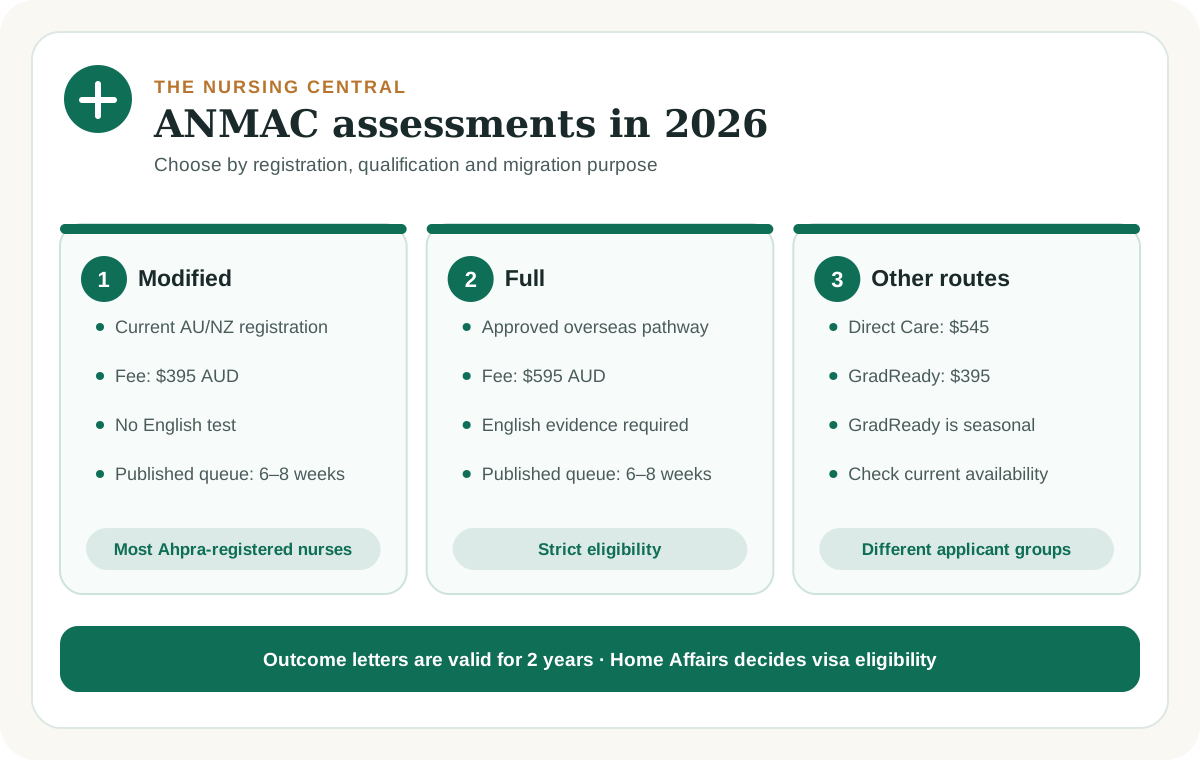
1. Modified skills assessment – $395 AUD
This is for applicants who hold current registration with NMBA/Ahpra, the Nursing Council of New Zealand or the Midwifery Council of New Zealand. ANMAC currently publishes a 6–8 week wait for assessment to start. An English test is not required for the Modified assessment.
2. Full skills assessment – $595 AUD
The Full assessment is for eligible nurses or midwives registered in an approved overseas country who meet strict qualification, registration, examination and recent-practice requirements. Approved countries currently include Canada, Hong Kong, Ireland, Singapore, Spain, the United Kingdom and the United States, but country of registration alone does not establish eligibility.
For some qualifications, applicants also need evidence of a qualification leading to registration after 1 January 2017, an approved regulatory examination and at least 1,800 hours of paid RN practice since that date in the relevant approved country. Check the exact criteria before paying. The published wait for assessment to start is currently 6–8 weeks.
3. Direct Care skills assessment – $545 AUD
Direct Care is for migration occupations such as certain aged or disabled care roles. It is not an alternative nursing-registration pathway. Its eligibility, qualifications and work evidence are different from those for a registered nurse.
4. GradReady skills assessment – $395 AUD
GradReady is a limited-time route for recent graduates of eligible Australian nursing or midwifery courses who have applied for Ahpra registration. For 2026, ANMAC lists availability from 1 July to 31 August. It is not the old “Modified PLUS” assessment and is not available year-round.
| Assessment | Main eligibility signal | English evidence to ANMAC | Published fee |
|---|---|---|---|
| Modified | Current AU/NZ nursing or midwifery registration | No | $395 |
| Full | Eligible overseas registration plus pathway criteria | Yes | $595 |
| Direct Care | Eligible direct-care occupation evidence | No for the ANMAC assessment | $545 |
| GradReady | Recent eligible Australian graduate who has applied to Ahpra | Check current pathway instructions | $395 |
ANMAC application process
- Confirm that your visa pathway requires an assessment. Check Home Affairs or obtain registered migration advice.
- Use ANMAC’s eligibility questions. Select the assessment that matches your registration and qualification.
- Prepare every required document. Requirements differ by assessment type.
- Arrange third-party verification. Overseas regulators may need to send verification of registration or a certificate of good standing directly to ANMAC.
- Submit, pay and upload the complete set. Upload everything together where possible.
- Monitor the portal and respond. The published wait time is when assessment is expected to start, not a guaranteed completion date.
- Check the outcome letter. Verify the ANZSCO code, qualifications, assessed employment and expiry date.
Document rules that commonly cause delays
- Upload clear, colour copies of original documents; ANMAC currently requests scans at 600 dpi or higher and PDF unless another format is specified.
- Include every page and avoid cropped, blurred or altered files.
- For non-English documents, upload the original and an English translation completed by a NAATI-certified translator.
- Overseas registration verification must come directly from the regulator by official email or post. ANMAC does not accept official documents sent from free email accounts such as Gmail or Yahoo.
- Professional references must come from an appropriate clinical supervisor and meet ANMAC’s required content and verification rules.
- Choose an ANZSCO code supported by your qualification and, where required, your employment evidence.
English requirements for a Full assessment
ANMAC’s current Full-assessment scores are not identical to every AHPRA or visa score profile. Results must generally be less than two years old, from the same test provider and taken at an authorised test centre. A maximum of two sittings within 12 months may be combined when the test-specific rules are met.
| Test | Current ANMAC Full-assessment minimum |
|---|---|
| IELTS Academic | Overall 7; Listening 7, Reading 7, Speaking 7, Writing 6.5 |
| OET for nurses | B in Listening, Reading and Speaking; C+ in Writing |
| PTE Academic | Overall 66; Listening 66, Reading 66, Speaking 66, Writing 56 |
| TOEFL iBT | Total 94; Listening 24, Reading 24, Writing 24, Speaking 23 |
| Cambridge C1 Advanced / C2 Proficiency | Overall 185; Listening 185, Reading 185, Speaking 185, Writing 176 |
Home Affairs changed visa English-test requirements on 7 August 2025. A score that works for ANMAC or AHPRA does not automatically give you Proficient or Superior English for migration points.
Employment evidence and migration points
If you want employment included in the outcome letter for visa-point purposes, ANMAC currently requires evidence meeting minimum thresholds: 12 months / 1,040 hours of paid Australian work or 36 months / 3,120 hours of paid overseas work. This does not itself award points; Home Affairs makes that decision.
Outcome letter validity
A successful ANMAC outcome letter is generally valid for two years from the date of issue. Check the date, nominated ANZSCO code and any employment periods recorded. If circumstances change, ANMAC provides a paid outcome-letter update service.
My ANMAC experience
My first ANMAC application was not successful. After building three months of Australian aged-care experience and submitting updated evidence, my second application was approved. The lesson is not that three months will solve every case; it is that the selected assessment, ANZSCO code and supporting evidence must fit your actual circumstances.
Common mistakes to avoid
- Applying because an online guide says ANMAC is always required.
- Choosing Full when current Ahpra registration makes Modified the relevant assessment.
- Using the discontinued Modified PLUS label.
- Submitting a personal scan of a document that must come directly from a regulator.
- Assuming ANMAC and Home Affairs apply the same English or work-experience rules.
- Counting the 6–8 week queue as a guaranteed total processing time.
- Treating a positive skills assessment as a visa guarantee.
Plan the steps around your ANMAC assessment
ANMAC is one part of a wider registration and migration process. Use these free guides to check the steps that come before and after your skills assessment.
- AHPRA registration guide: understand the registration pathway that may come before ANMAC.
- English tests compared: check OET, IELTS, PTE and TOEFL requirements.
- Australian visa guide for nurses: see where a skills assessment may fit for 482, 186, 189, 190 and 491 visas.
- Migration resource hub: view the full pathway in one place.
- Free eligibility wizard: get an educational starting point in about two minutes.
ANMAC questions international nurses ask
Do I need AHPRA registration before applying to ANMAC?
It depends on the assessment type. Modified assessment is for applicants with current Australian or New Zealand registration. Full assessment is for nurses or midwives registered in an eligible overseas country, while GradReady is for eligible recent Australian graduates awaiting registration. Use ANMAC’s current eligibility check before paying.
Can nurses trained in India or the Philippines use the Full Skills Assessment?
Do not assume so. ANMAC currently limits Full assessment to applicants who meet its eligible-country, qualification and registration criteria. If your training or registration is outside that list, check the current ANMAC assessment selector and your AHPRA route first.
Is ANMAC required for every Australian nursing visa?
No. The requirement depends on the visa subclass and stream. It is central to points-tested skilled migration, while some employer-sponsored pathways may use different evidence. Check the current Home Affairs criteria for the exact visa stream; ANMAC does not decide visa eligibility.
How long does an ANMAC skills assessment take?
Published processing information can change and delays often depend on document completeness and third-party verification. Treat any estimate as planning guidance, not a deadline, and check ANMAC’s live information before applying.
Does a suitable ANMAC outcome guarantee a visa?
No. A suitable skills assessment supports a migration application but does not guarantee an invitation, nomination or visa grant. Home Affairs and, where relevant, a state or territory assess the remaining criteria.
Official sources
- ANMAC – Modified skills assessment
- ANMAC – Full skills assessment
- ANMAC – Direct Care skills assessment
- ANMAC – GradReady skills assessment
- ANMAC – Current fees
- ANMAC – Frequently asked questions
GENERAL INFORMATION
Not personal migration advice
This guide summarises public ANMAC information and personal experience. Check the assessment page in force when you apply. For visa strategy or individual eligibility, use Home Affairs or a registered migration professional.