Every international nurse coming to Australia has to prove their English. For most, this is the first concrete cost of the migration — before AHPRA, before ANMAC, before the visa. And the choice of test matters: it determines how much you pay, how long you wait for results, and sometimes whether you get registered or invited at all.
AHPRA accepts four tests: OET, IELTS Academic, PTE Academic and TOEFL iBT. This guide explains what each one requires in 2026, what they really cost, how long they take to book and complete, and which one fits which type of nurse. The honest answer is: it depends on what you are good at, not on what sounds best on paper.
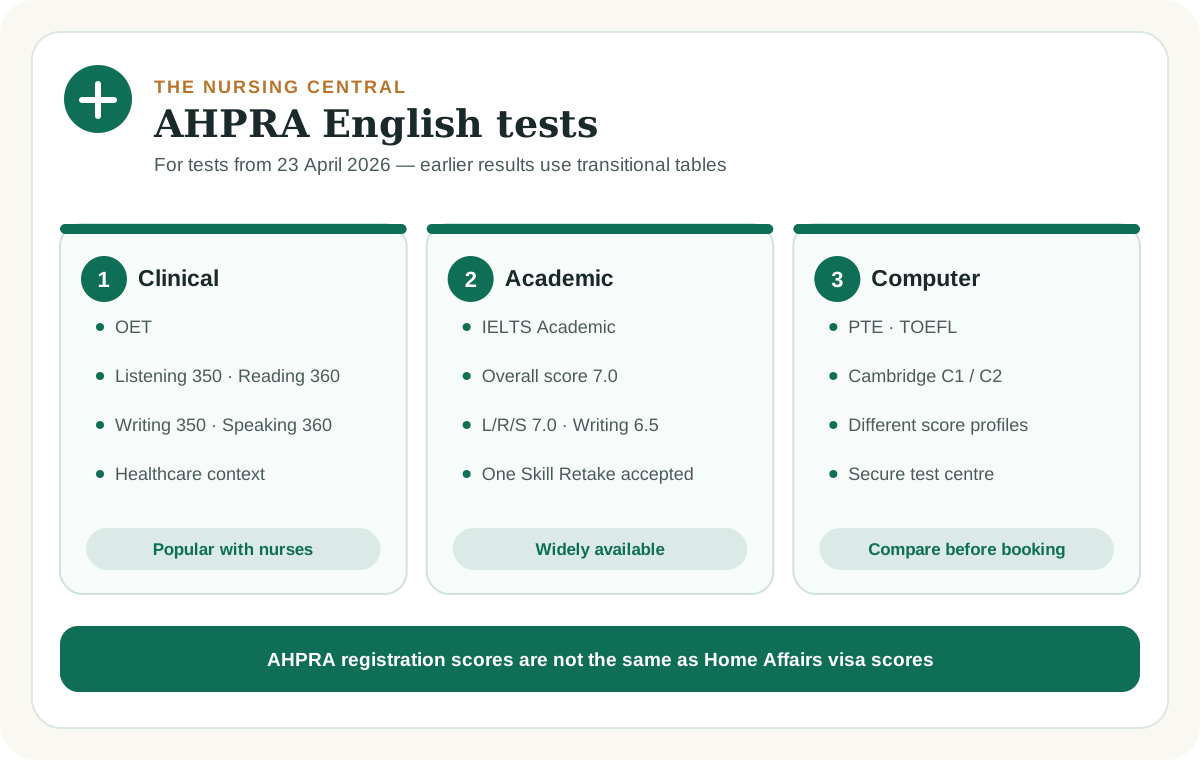
The 4 tests AHPRA accepts, at a glance
AHPRA’s English language requirement applies to most international applicants. There are a few exemptions (qualification from a recognised English-speaking country, primary and secondary education in English in specific countries, etc.) but the great majority of overseas-trained nurses have to sit one of these:
| Test | AHPRA minimum | Format | Cost (AUD) | Results in |
|---|---|---|---|---|
| OET | B in each of 4 subtests | Paper or computer, ~3 hours, nursing-themed | ~$635 | ~16 business days |
| IELTS Academic | 7.0 overall, min 7.0 each band | Paper or computer, ~2h45m, generic academic | ~$410 | 3–13 days depending on format |
| PTE Academic | 65 overall, min 65 each communicative skill | Computer only, ~2h, generic academic | ~$410 | 2–5 business days |
| TOEFL iBT | 94 total + L24, R24, W27, S23 | Computer, ~2h, generic academic | ~USD $250 | ~10 days |
Note that the AHPRA minimum is the registration floor. If you also need migration points for a 189, 190 or 491 visa, the bar is higher — see the section on Superior English below.
The “combined test” rule
AHPRA allows you to combine scores across up to two test sittings within 6 months if all scores in each sitting meet the relevant minimum. So if you sit OET and score B/B/C+/B, you cannot combine — Writing is below B. But if you score B/B/B/C+ in one sitting and then C+/B/B/B in another, you can combine the best subtests across both, provided every score is at least C+ in each sitting and the final combination meets B in all four. The same logic applies to IELTS, PTE and TOEFL.
This rule has saved a lot of nurses from re-sitting an entire 3-hour test because of one weak subtest. The catch: you cannot mix tests. OET scores combine with OET scores only, IELTS with IELTS only, etc.
Two questions that decide which test
Before going deep into each test, answer these:
- Are you going for AHPRA registration only, or do you also need migration points? If AHPRA only, the minimums above are all you need. If you are going via the 189, 190 or 491 visa, you probably need Superior English — 20 visa points, which translates to OET A, IELTS 8.0 each band, PTE 79+, or TOEFL 28+/24+/27+/24+ (L/R/W/S). That is a very different test difficulty.
- Is your day-to-day vocabulary medical or general? If you work in healthcare every day and naturally read clinical texts, OET will feel like a normal day at work. If you read more general academic English (university study, news, business), IELTS or PTE will be easier than learning medical vocabulary from scratch. Many nurses underestimate how foreign IELTS topics — global warming, urban planning, art history — can feel after years of clinical practice.
OET — the nurse-specific option
The Occupational English Test (OET) is designed specifically for healthcare professionals. The Listening, Reading, Writing and Speaking sections all use medical contexts. The Writing task for the nursing version is a referral letter, the Speaking is two role-plays as a nurse with a patient or carer, and the Reading and Listening texts are clinical articles, case notes, and ward conversations.
Why nurses pick OET
- Vocabulary is in your wheelhouse: terms like dysphagia, comorbidity, capillary refill and discharge summary are all on the test. If you have worked clinically, you do not need to learn this; you already use it.
- Writing task is a referral letter: nurses write these every day. The structure is predictable — case background, current issue, request for action. Closer to clinical handover than an IELTS argumentative essay.
- Speaking is role-play: patient education, history-taking, breaking news. Activities you have already done thousands of times in real wards.
- Bands map cleanly: OET B is the AHPRA minimum, OET A is Superior English for visa points. Easier to plan against than IELTS bands.
Why some nurses skip OET
- It is the most expensive: around AUD $635 per sitting in 2026 (overseas pricing varies; check the official OET site). About 50% more than IELTS or PTE.
- Fewer test dates: OET on Paper runs roughly twice a month; OET on Computer is more frequent (3–4 dates per week in major cities) but availability is still tighter than IELTS or PTE.
- Results take longer: ~16 business days vs ~5 days for PTE.
- If your clinical English is weak, you cannot escape it on OET. IELTS at least lets you fall back on general academic vocabulary you might know better.
IELTS Academic — the cheap, ubiquitous default
IELTS Academic is the most-taken English test in the world. There are IELTS centres in almost every major city and many smaller ones. The format is fixed: Listening (30 min), Reading (60 min), Writing (60 min), Speaking (11–14 min). The Academic version uses university-style texts and tasks.
Why nurses pick IELTS
- Cheaper than OET: around AUD $410 per sitting, sometimes less for IELTS on Computer.
- Many more test dates: most centres run IELTS on Paper weekly and IELTS on Computer daily or near-daily in big cities.
- Free preparation material everywhere: Cambridge official practice books, British Council resources, hundreds of YouTube channels, thousands of past papers. The OET ecosystem is much smaller.
- Faster results on IELTS on Computer: 3–5 days typically; IELTS on Paper takes 13 days.
Why nurses struggle with IELTS
- 7.0 in EVERY band is harder than it sounds, especially Writing. A single 6.5 in Writing means the entire test does not meet AHPRA. Many nurses scrape 8.0 in Listening and Reading and then plateau at 6.5 in Writing.
- Topics are unpredictable and generic: you might write 250 words on climate policy, education reform, or urbanisation. If your reading is mainly clinical, this is a real cognitive load.
- Task 1 graph descriptions use academic vocabulary (fluctuate, plateau, surge, marginal) that nurses do not use day-to-day.
- The Speaking topics are random: hometown, favourite season, memorable holiday, social media habits. Different muscle from clinical communication.
PTE Academic — the speed option
PTE Academic is fully computer-based and AI-marked, which makes the results process much faster than human-marked tests. The format is integrated — speaking and writing tasks are mixed throughout the 2-hour test rather than split into discrete sections.
Why nurses pick PTE
- Results in 2–5 business days: by far the fastest of the four tests. Useful if you are racing a visa lodgement deadline or an AHPRA processing window.
- AI-marked: no examiner bias to worry about, more predictable scoring once you understand the algorithm’s preferences (clear pronunciation, fluency over content depth in some tasks).
- Test dates daily in most major cities: easy to book.
- Same cost as IELTS: around AUD $410.
Why some nurses avoid PTE
- You speak to a computer, not a person: many candidates find this unnerving. There is no human cue to pace yourself, you just talk into a microphone.
- The AI rewards specific patterns: fluency, clear pronunciation, structured templates. If your speaking style is naturally hesitant or accented, you may need extra prep to score well even if your English is fundamentally strong.
- Headphones and microphone setup matters: test centre equipment varies. Background noise from other candidates can affect scoring.
- Integrated skills (speaking + writing tasks combined) confuse some test-takers used to traditional discrete-skill tests.
TOEFL iBT — accepted but rarely the right choice
TOEFL iBT is accepted by AHPRA but rarely the optimal choice for nurses heading to Australia. It is more commonly used for US/Canadian university admissions. The minimum scores AHPRA requires (94 overall, with specific minimums across 4 sections) are achievable but the test is North-America-oriented.
- Use it if you have already sat TOEFL recently (within 2 years) and have a strong score — saves you a re-sit.
- If starting from scratch, OET, IELTS or PTE will almost always be cheaper and have more local test centres in your country.
- The minimum thresholds are not directly comparable to OET B or IELTS 7.0 — TOEFL Writing 27 is high, often the bottleneck for non-native speakers.
What “Superior English” costs you (for visa points)
For nurses pursuing the 189, 190 or 491 visa, your English score is the cheapest 10 visa points you can buy. Going from Competent (no points) to Proficient (10 points) and then to Superior (20 points) often makes the difference between “never invited” and “invited next round.”
| English level | Visa points | OET | IELTS each band | PTE each skill |
|---|---|---|---|---|
| Competent (AHPRA min) | 0 | B (~6.5) | 7.0 | 65 |
| Proficient | +10 | (no equivalent — must use IELTS/PTE/TOEFL) | 7.0 overall, min 7.0 | 65 |
| Superior | +20 | A | 8.0 overall, min 8.0 | 79+ |
Worth knowing: OET only counts for migration points at the Superior level (OET A = 20 points). For the Proficient (10 points) band, you have to sit IELTS, PTE or TOEFL. This is a frustrating quirk for OET-loyal nurses — if you scored OET B (which satisfies AHPRA), you get 0 visa points. If you want 10 visa points without going for the Superior tier, you have to take a second test.
Real cost comparison: start to finish
The test fee is rarely the total cost. Add preparation materials, possible re-sits, and the opportunity cost of how long it takes to get a usable result. A realistic budget per test:
| Component | OET | IELTS | PTE |
|---|---|---|---|
| Test fee | $635 | $410 | $410 |
| Prep materials (books, courses) | $100–$400 | $50–$300 | $50–$250 |
| Realistic re-sits to hit B / 7.0 | 1.4 (average) | 1.6 (Writing common fail) | 1.5 |
| Total realistic outlay | $890–$1,290 | $715–$960 | $680–$910 |
The “realistic re-sits” number is rough — based on candidate survey data and informal industry estimates rather than official statistics. If your English is genuinely strong, you may pass first time and save the re-sit cost. If you are working full time and studying part time, plan for at least one re-sit on any test.
The “which one for you” decision tree
- You work in healthcare daily, have not studied formal English in years → OET. The vocabulary is yours, the tasks mirror your work.
- You need 20 visa points (Superior English) for 189/190/491 → OET A or IELTS 8.0. Pick whichever you are stronger in. PTE 79+ also qualifies but is harder to predict.
- You need the result urgently (visa lodgement countdown, AHPRA decision pending) → PTE. Fastest turnaround by far.
- You read general English well (news, novels, blogs), not just clinical → IELTS. Easier than learning OET-specific medical vocabulary from scratch.
- You are uncomfortable with computer-based testing or interviews via headphones → OET on Paper or IELTS on Paper.
- You speak naturally fluent English but freeze in live interviews → PTE. No human examiner pressure.
- You have already sat a recent test (within 2 years) at a passing level → use that score, do not start over.
5 common English-test mistakes nurses make
1. Booking the test before any prep
“My English is fine, I will just sit it.” The most common reason for failing OET Writing is using clinical shortcuts (abbreviations, fragments) that work in nursing notes but lose marks on the test. The most common reason for failing IELTS Writing is treating Task 2 like a casual essay rather than a structured argument with introduction, body paragraphs and conclusion. Both are fixable in 4–6 weeks of focused practice. Sit a free practice test first, identify the weak section, then book the real test.
2. Treating Speaking as a language test instead of a communication test
OET Speaking is a role-play with a real human examiner playing the patient. Nurses who try to “speak perfect English” with stilted grammar score worse than nurses who communicate naturally with normal speed, eye contact and acknowledgement. The same applies to IELTS Speaking. Forget the language test framing; do it like a real clinical interaction.
3. Underestimating Writing
Across OET, IELTS and PTE, Writing is the section nurses most often fail. It is a different skill from Speaking — you have time to think but you also have to be precise, structured and grammatically clean. Allocate 50% of your prep time to Writing alone. Practice with a tutor or a peer who will give you brutally honest feedback on grammar and structure.
4. Switching tests after one bad result
Failed OET Writing? Many nurses pivot to IELTS, fail there too, then try PTE. Each switch costs you 6–8 weeks of new prep and another $400+ in fees. If you failed by one band in one subtest, re-sit the SAME test with focused prep on that section. The combined-test rule across two sittings within 6 months is your friend.
5. Forgetting that AHPRA and visa requirements differ
AHPRA is happy with OET B / IELTS 7.0 / PTE 65 across the board. But if you are going for migration points, the bar is OET A / IELTS 8.0 / PTE 79. Plan for the highest requirement you need, not just AHPRA. Re-sitting an English test to upgrade from Proficient to Superior is the single cheapest 10 points you will ever buy in this migration journey.
How this fits with AHPRA, ANMAC and visa
The English test is usually the first step of the migration sequence. The rough order is:
- English test — book, prep, sit, get result. 2–6 months.
- AHPRA application — submit with English score, choose pathway (Stream A IQRN, OBA, etc.). 3–14 months depending on pathway.
- ANMAC skills assessment (in parallel with AHPRA once in-principle is in hand). 8–12 weeks.
- Visa application (482 employer-sponsored or 189/190/491 independent). Months 6–24 of the overall journey.
The TNC guides cover each stage in detail:
- AHPRA Registration for Nurses 2026 — registration pathways and processes
- ANMAC Skills Assessment for Nurses 2026 — skills assessment process
- Australian Visas for International Nurses 2026 — the 6 visa subclasses and how to choose
Get personalised guidance
Not sure which test fits your situation?
Take the free 2-minute eligibility wizard. Six questions about your country, qualification and goals — and you get a personalised AHPRA pathway, ANMAC pathway, and visa subclass recommendation. The English test that fits your goals is part of the output. No signup, no email.
One last honest note
There is no “best” English test for nurses. The test that works is the one you can pass at the level you need. Spend an evening doing free sample tests from each (OET, IELTS and PTE all publish free samples on their official sites). See which format feels most natural. Then commit to that one and prepare seriously rather than test-shopping after every weak result.
If you spot an error in this guide or something has changed since publication, please let me know.
This article is for general educational purposes. Test fees, formats and requirements change — always verify directly with OET, IELTS, PTE or TOEFL official sources and the AHPRA English language skills registration standard before sitting.